




If you have ever stepped foot inside a commercial gym, fitness studio or home workout space, you have almost certainly encountered a massive, intimidating piece of steel framework with a sliding sled and heavy weight plates stacked high. It is usually the corner of the gym where people gather to test their lower body strength or grind through intense leg day finishers. But stripped back to basics, what is a leg press machine, how does it actually work, and why should you consider making it a central pillar of your weekly fitness routine?
When building a well-rounded physique or developing functional strength, lower body training is non-negotiable. While the traditional barbell squat often steals the spotlight as the king of leg exercises, it is not always the best fit for everyone. Injury history, mobility limitations or simply a desire to isolate specific muscle groups without fatiguing your lower back can make free weight squats incredibly challenging. This is exactly where the leg press machine steps in as an absolute game-changer.
In this comprehensive, deep-dive guide, we will unpack everything you need to know about this powerhouse piece of gym kit. We will explore the different variations you will spot on the gym floor, the precise muscles targeted, safe technical execution, and how to program it to unlock your ultimate lower body potential.
Defining the Equipment: What is a Leg Press Machine?
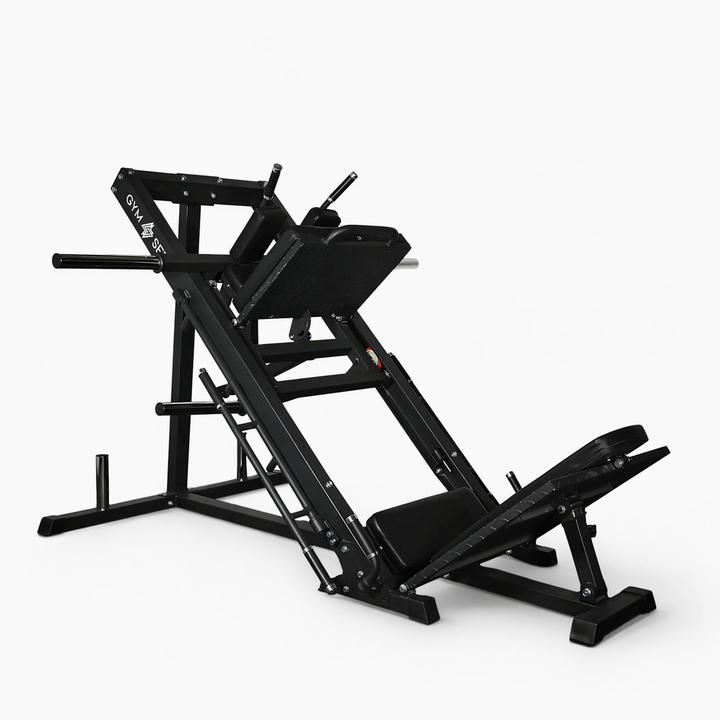
At its core, a leg press machine is a stationary piece of resistance training equipment designed to isolate and strengthen the major muscle groups of your lower body. Instead of holding a heavy weight across your shoulders or in your hands, the machine provides a built-in seat and backrest to support your torso. You plant your feet flat against a heavy, metallic footplate and push the weight away from you by extending your knees and hips.
The primary beauty of this design lies in its stability. Because your upper body is entirely supported by a padded seat, the need for complex balance, core stabilization and spinal loading is virtually eliminated. This allows you to focus purely on forcing your legs to work against a chosen resistance, making it an incredibly safe, controlled and effective way to push your lower body muscles right to the absolute limit.
For beginners, the leg press serves as an excellent introduction to heavy lower body mechanics without the fear of falling over or dropping a barbell. For advanced lifters, it offers a high-volume hypertrophy tool to stimulate muscle growth without draining the central nervous system through exhausting core stabilization.
The Main Types of Leg Press Machines
Walk into any modern fitness facility and you will quickly notice that not all leg press machines look or feel the exact same. There are two primary variations that dominate the fitness industry, alongside a couple of niche models. Understanding how these designs differ is essential for optimising your workouts.
1. The 45-Degree Incline Leg Press
This is arguably the most common model found in commercial gyms. On a 45-degree incline machine, your seat remains close to the floor, and you lie back at an angle. The footplate sits above you on a track system. You load Olympic-style weight plates onto the pegs attached directly to the moving sled. To perform the movement, you press the sled upward along the angled tracks, disengage the safety catches, and lower the weight down toward your chest before pressing it back up. Because you are pushing the weight up an incline against the direct pull of gravity, this style typically allows you to lift heavier loads while providing an intense stretch through the glutes and quadriceps.
2. The Horizontal or Seated Cable Leg Press
The horizontal leg press keeps your body in an upright, seated position, closely mimicking how you sit in an office chair. Your feet are placed on a platform directly in front of you. Rather than loading heavy iron plates by hand, this machine uses a closed weight stack with a selector pin. When you press against the footplate, a high-tensile cable and pulley system lifts the selected plates from the stack. On some horizontal models, the footplate moves away from you. On others, the footplate remains static and your entire seat pushes backward along a horizontal track. This design is exceptionally user-friendly, quick to adjust between sets, and offers a highly consistent resistance profile throughout the entire range of motion.
3. The Vertical Leg Press
Though much less common in mainstream commercial gyms due to its intense nature, the vertical leg press can still be found in specialized bodybuilding gyms and home setups. With this machine, you lie completely flat on your back on the floor, looking straight up at the ceiling. The footplate sits directly above your hips. You press the weight vertically upward into the air. This variation places zero stress on the lower back but requires excellent hamstring and hip mobility to execute safely, as the weight drops straight down toward your torso.
What Muscles Does the Leg Press Machine Target?
The leg press is inherently a compound movement, meaning it recruits multiple joints and muscle groups simultaneously. It primarily targets the anterior and posterior chains of your lower half. Let us break down exactly which muscles are doing the heavy lifting during each repetition.
-
The Quadriceps: Situated on the front of your thighs, your quadriceps are the primary drivers of the leg press. This muscle group consists of four individual muscles: the rectus femoris, vastus lateralis, vastus medialis, and vastus intermedius. Their primary job is knee extension, which means they do the absolute bulk of the work as you press the footplate away and straighten your legs.
-
The Gluteus Maximus: Your glutes, or buttock muscles, are heavily recruited during the lower portion of the movement. As you bring the weight down toward your torso, your hips enter a deep state of flexion. Pressing the weight back out requires powerful hip extension, forcing the glutes to fire aggressively to jumpstart the upward phase of the lift.
-
The Hamstrings: Running along the back of your thighs, the hamstrings act as crucial stabilizers during the leg press. While they do not experience the same level of isolated tension as they would during a deadlift or leg curl, they work alongside your glutes to control the descent of the weight and assist in pushing through the heel during the ascent.
-
The Adductors: Located on the inner thigh, the adductor muscles work behind the scenes to keep your knees tracking beautifully in line with your toes, preventing your legs from collapsing inward under heavy loads.
How to Use a Leg Press Machine Safely: Step-by-Step
To extract the maximum muscle-building benefit from the leg press while protecting your joints from unnecessary wear and tear, mastering your form is absolutely vital. Use the following sequential checklist to perfect your execution on your very next gym session.
Critical Mistakes to Completely Avoid
Despite being a guided machine exercise, it is still entirely possible to get things wrong on the leg press. Avoiding these common gym floor blunders will safeguard your longevity and keep your joints feeling fantastic.
Lifting the Lower Back off the Padding
This is undoubtedly the most dangerous mistake seen on the leg press. When you lower the footplate too deep, past your natural hip mobility limits, your pelvis rotates backward in a movement known as a posterior pelvic tilt or a "butt wink". This lifts your lumbar spine completely off the supportive back pad, exposing your lower back discs to massive spinal compressive forces under heavy loads. Always prioritize keeping your spine glued to the padding over chasing an excessively deep range of motion.
Complete Knee Lockout at the Top
Snapping your knees into a rigid, bone-on-bone lockout at the top of a heavy repetition is a recipe for disaster. When the knees lock out, the muscular tension drops to zero, and the entire load shifts directly onto the ligaments, meniscus and joint capsules. Keep your muscles actively working by stopping your extension just an inch short of absolute lockout.
Allowing the Knees to Collapse Inward
Known mathematically as knee valgus, allowing your knees to cave toward each other during the pressing phase places immense, destructive shear stress across the anterior cruciate ligament (ACL) and the medial collateral ligament (MCL). If you notice your knees caving, it is usually a sign that the weight stack is far too heavy, or that your hip external rotators need strengthening. Drop the load and focus on forcing your knees outward so they track inline with your shoe laces.
Ego Lifting and Partial Repetitions
Loading up every single weight plate in the gym just to move the platform a mere two inches downward is incredibly common, but highly ineffective for muscle building. Short partial reps do not stretch the muscle fibres under load, which severely limits muscle building hypertrophy. Use a weight that allows you to achieve a clean, deep, ninety-degree angle at the knees with flawless control.
How Foot Placement Modifies the Exercise
One of the coolest features of the leg press machine is the sheer size of the footplate. By simply shifting where you place your feet on the platform, you can subtly alter the joint angles, changing which muscle group takes on the majority of the work.
| Foot Position | Muscle Emphasis | How It Works |
| High on the Plate | Glutes and Hamstrings | Increases hip extension while reducing the forward travel of the knees. |
| Low on the Plate | Quadriceps | Forces the knees into a deeper angle of flexion, isolating the front of the thighs. |
| Wide Stance | Inner Thighs (Adductors) | Recruits the inner thigh muscles and deep glute structures. |
| Narrow Stance | Outer Thigh (Vastus Lateralis) | Shifts the mechanical load toward the outer sweep of the quadriceps. |
While these foot placement variations are fantastic for advanced bodybuilders looking to fine-tune their physique, beginners should stick to a standard, central, shoulder-width stance to establish a rock-solid foundation of baseline strength.
Leg Press vs. Barbell Squat: Which is Superior?
The debate between the leg press machine and the traditional barbell squat has raged in gym changing rooms for decades. The truth is, neither machine or movement is globally superior; they are simply different tools engineered for entirely different training goals.
The barbell squat is a functional, total-body, free-weight movement. It requires immense core stability, balance, coordination, and upper back strength to hold a bar while moving your body through space. It trains your body to work as a unified system, making it incredibly effective for athletic performance, bone density development, and functional everyday strength. However, because your lower back and core often act as the weak link, your legs might not get fully pushed to their absolute limits.
The leg press machine removes balance and core stabilization entirely from the equation. Because your torso is locked into place, your lower back is safe, and your nervous system does not have to worry about you falling over. This allows you to purely isolate the legs, loading them with intense weight that your upper back could never dream of holding. If your absolute primary goal is pure muscle hypertrophy, isolation, or working around an existing back injury, the leg press easily wins the round. For most people, combining both movements within a structured training split yields the absolute best of both worlds.
How to Program the Leg Press into Your Workouts
To get the most out of the leg press machine, you need to think about how it slots into your overall training structure. Because it is a compound lift that allows for heavy loading, it typically works best near the beginning or middle of your lower body workouts.
If you are training for raw strength, consider performing the leg press early in your session for 3 to 4 sets of 6 to 8 repetitions, focusing on heavy, controlled loads with 2 minutes of rest between sets. If your goal is pure muscle building and metabolic stress, it serves as an unbelievable high-volume option. Try performing 3 sets of 12 to 15 repetitions, focusing intensely on the slow, negative portion of the lift to maximize muscular damage and blood flow.
It is also an elite tool for advanced training techniques like drop sets. Because changing the weight on a horizontal cable stack takes less than two seconds, you can perform a set to failure, immediately pull the pin out, drop the weight by twenty percent, and instantly keep pressing to take your leg development to a whole new level.
Final Thoughts: The Verdict on the Leg Press
What is a leg press machine? It is far more than just a big piece of steel taking up space in the gym. It is one of the safest, most efficient, and highly versatile lower body training tools available to modern fitness enthusiasts. Whether you are an absolute beginner looking to build your very first layer of leg strength, an athlete recovering from an injury, or an experienced lifter trying to add serious mass to your quads without killing your lower back, the leg press deserves a permanent home in your routine.
Focus on controlled tempos, keep your spine firmly pressed against the padding, leave your ego at the gym door, and use smart foot placements to unlock the incredible lower body benefits this classic machine has to offer.