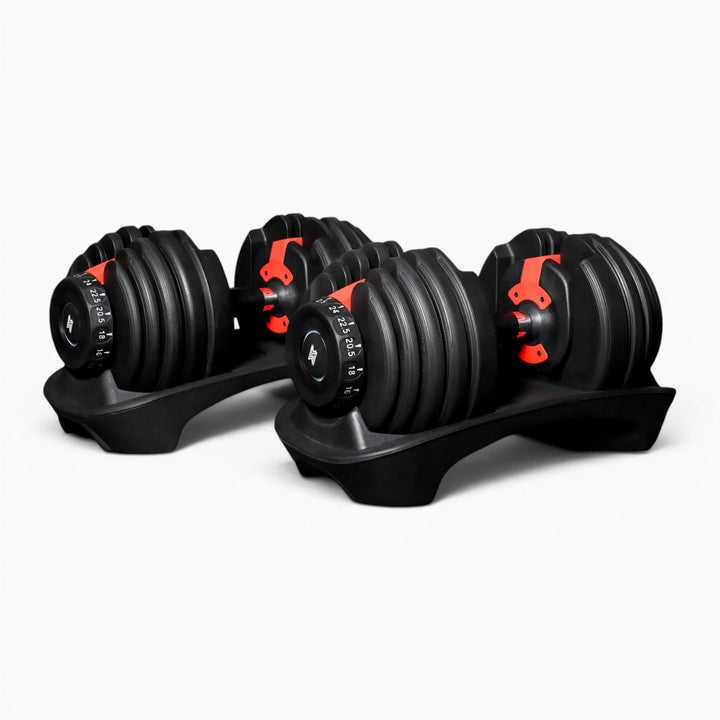


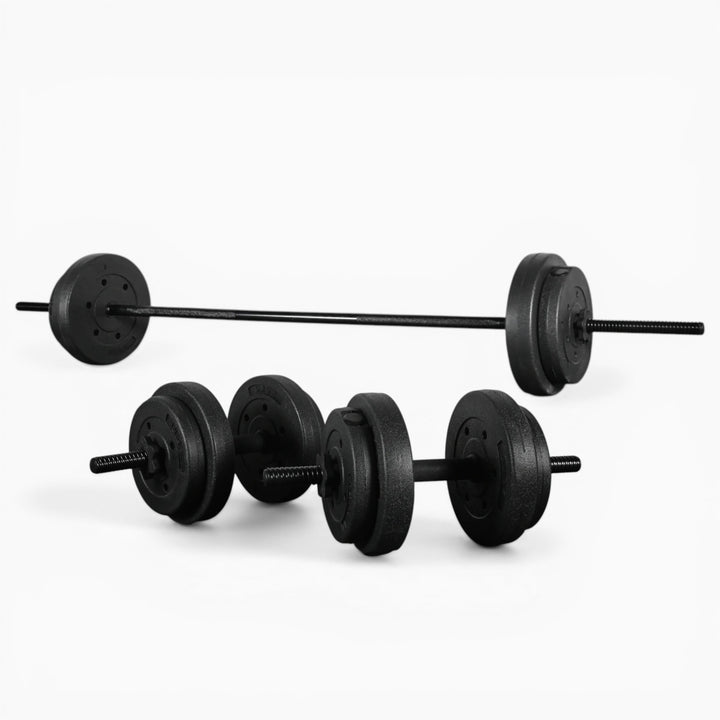


The best exercises with a 24kg adjustable dumbbell are compound movements that train several muscles at once, including goblet squats, Romanian deadlifts, dumbbell presses, rows, lunges and shoulder presses. With adjustable weight, one dumbbell can support a surprisingly varied full-body workout.
In this guide, we’ll cover the best exercises you can perform with a 24kg adjustable dumbbell, which muscles they target, how to perform them safely and how to combine them into an effective home workout. We’ll also look at how to choose the right weight and progress as you get stronger.
Why train with a 24kg adjustable dumbbell?
A 24kg adjustable dumbbell is a versatile piece of home gym equipment because it gives you access to multiple resistance levels without needing a full rack of fixed-weight dumbbells. You can use lighter settings for exercises such as lateral raises and heavier settings for movements like squats, rows and deadlifts.
That flexibility matters because different exercises and muscle groups require different amounts of resistance. The weight you can comfortably use for a bicep curl, for example, will usually be very different from the weight you can use for a Romanian deadlift.
For home training, an adjustable dumbbell can also help reduce the amount of equipment you need. Instead of changing between several pairs of dumbbells, you can adjust the resistance to suit the exercise and your current strength level.
1. Goblet squat
The goblet squat is one of the best lower-body exercises you can perform with a 24kg adjustable dumbbell. It primarily works your quadriceps and glutes while also challenging your core to keep your torso stable.
Hold one end of the dumbbell securely with both hands and position it close to your chest. Keep your chest lifted, sit down into the squat under control and drive through your feet to return to a standing position.
The adjustable design makes this exercise suitable for a wide range of fitness levels. You can begin with a lighter load while practising your technique and gradually increase the weight as your legs become stronger.
Goblet squats are also easy to fit into a home workout because they do not require a barbell or squat rack. All you need is enough floor space to move comfortably and safely.
2. Dumbbell Romanian deadlift
A dumbbell Romanian deadlift is an excellent exercise for training your hamstrings and glutes. It also encourages you to practise the hip-hinge movement, which is useful across many forms of strength training.
Hold the dumbbell securely with both hands in front of your thighs. Push your hips backwards while keeping your back neutral, lowering the weight towards the floor until you feel a comfortable stretch through the back of your legs.
Drive your hips forwards to return to the starting position. The movement should come mainly from your hips rather than from bending and straightening your knees excessively.
A 24kg adjustable dumbbell gives you plenty of room to progress with this exercise. Because the glutes and hamstrings are relatively strong muscle groups, many people can gradually work towards heavier resistance here than they would use for smaller upper-body movements.
3. Single-arm dumbbell row
The single-arm dumbbell row is one of the most effective exercises for training your back with limited equipment. It mainly targets the muscles of the upper and mid-back while also involving your biceps and core.
Support yourself with your free hand on a sturdy bench or another stable surface if needed. Pull the dumbbell towards your hip, keeping your movement controlled rather than using momentum to swing the weight.
Pause briefly at the top before lowering the dumbbell under control. Complete your chosen number of repetitions on one side before switching to the other.
Rows work particularly well with an adjustable dumbbell because you can use a heavier weight than you might use for isolation exercises. If your 24kg dumbbell reaches your current strength limit, you can also increase the challenge by slowing the lowering phase or performing additional repetitions.
4. Dumbbell floor press
The dumbbell floor press is a practical chest and triceps exercise for home workouts. Because you perform it lying on the floor, you do not necessarily need a weight bench.
Lie on your back with your knees bent and feet planted comfortably on the floor. Hold the dumbbell securely above your chest, lower it with control until your upper arm gently reaches the floor and then press the weight back upwards.
Using one dumbbell can also challenge your core and shoulder stability because each side of your body has to work to keep you balanced. Start with a manageable weight and focus on keeping the movement controlled throughout.
A floor press has a naturally limited range of motion compared with some bench pressing variations. That makes it a useful option when you want to train your pressing muscles at home with minimal equipment.
5. Standing shoulder press
The standing dumbbell shoulder press is an effective exercise for building strength in your shoulders and triceps. Performing the movement while standing also requires your core to help stabilise your body.
Begin with the dumbbell at shoulder height and press it overhead until your arm is comfortably extended. Lower it slowly back to the starting position before repeating or switching sides.
Avoid rushing through the exercise or leaning excessively backwards to move the weight. If you find yourself changing your body position significantly to complete a repetition, reducing the weight can help you maintain better control.
A 24kg adjustable dumbbell is particularly useful here because shoulder presses often require much less resistance than lower-body exercises. Being able to reduce the weight quickly means you can use the same piece of equipment for both demanding compound movements and lighter upper-body training.
6. Reverse lunge
The reverse lunge is an excellent way to train your legs one side at a time. It works the quadriceps and glutes while requiring balance and coordination.
Hold the dumbbell close to your chest or at your side, depending on which variation feels most stable. Step one foot backwards, lower yourself under control and then push through the front foot to return to standing.
Training each leg individually can help you focus on controlled movement rather than relying entirely on your stronger side. Start with bodyweight if necessary, then gradually introduce resistance as your balance and confidence improve.
A reverse lunge can be performed in a relatively small space, making it a useful exercise for home gyms. You can adjust the dumbbell to a lighter or heavier setting depending on your experience and the number of repetitions you want to complete.
7. Dumbbell hip thrust or glute bridge
A dumbbell glute bridge is a simple but effective exercise for the glutes. If you have a sturdy bench, you can progress to a hip thrust variation with a greater range of motion.
For a glute bridge, lie on your back with your knees bent and feet on the floor. Position the dumbbell securely across the front of your hips, then drive through your feet and squeeze your glutes as you lift your hips.
Pause briefly at the top and lower yourself under control. Using a towel or pad between the dumbbell and your hips may make the exercise more comfortable.
Because the glutes are powerful muscles, this is another movement where a 24kg adjustable dumbbell can provide useful resistance. As you get stronger, you can increase the load or make the movement more challenging by slowing the tempo.
8. Dumbbell split squat
The split squat is a highly effective lower-body exercise that can be performed without moving around the room. Once you are in position, your feet remain largely in place as you lower and raise your body.
Hold the dumbbell in a position that feels secure and allows you to stay balanced. Lower your back knee towards the floor, keeping the movement controlled, then push through your front foot to return to the starting position.
Split squats can feel challenging even with a moderate amount of weight. This makes them particularly useful when you have limited equipment but still want to train your legs with a significant amount of effort.
You can also adjust the weight between sets as needed. A lighter setting may be appropriate while learning the movement, while a heavier setting can help you continue progressing once your technique is established.
9. Single-arm dumbbell bench press
If you have a stable exercise bench, the single-arm dumbbell bench press can add another effective chest exercise to your training. It also places extra demands on your core because you need to resist twisting as you press.
Lie securely on the bench and position the dumbbell above your chest. Lower the weight with control before pressing it back up while keeping your torso as stable as possible.
Complete your repetitions on one side before changing arms. There is no need to use the maximum available weight; maintaining a controlled and stable movement is more important than lifting as heavily as possible.
Single-arm training can also make one adjustable dumbbell feel more useful. Rather than needing two matching weights, you can train each side individually and adjust the resistance according to the exercise.
10. Dumbbell bent-over row
The bent-over dumbbell row is another excellent exercise for the back. It can be performed with both hands holding one dumbbell, which makes it particularly practical if you only have a single adjustable weight.
Hinge forwards at the hips and keep your back neutral. Pull the dumbbell towards your lower ribs or upper waist, then lower it slowly and under control.
Try to avoid turning the movement into a swing. Using momentum may allow you to move a heavier weight, but controlled repetitions are generally a better choice for maintaining consistent technique.
The ability to increase resistance gradually makes a 24kg adjustable dumbbell useful for rows. You can also adjust your repetition range depending on whether you want to focus on heavier sets or slightly lighter, longer sets.
11. Dumbbell bicep curl
No list of the best exercises with a 24kg adjustable dumbbell would be complete without the bicep curl. It is a straightforward isolation exercise that primarily targets the biceps.
Stand upright and hold the dumbbell securely with your arm extended. Curl the weight towards your shoulder while keeping your upper arm relatively still, then lower it slowly.
Because the biceps are smaller muscles, you will usually use significantly less weight here than you would for exercises such as squats or deadlifts. This is where an adjustable dumbbell becomes particularly convenient.
Instead of owning multiple weights, you can reduce the resistance for curls and then increase it again for your larger compound exercises. Focus on controlled repetitions rather than swinging the weight with your body.
12. Overhead tricep extension
The overhead tricep extension is a useful exercise for directly training the triceps. It can be performed seated or standing, depending on your available space and preference.
Hold one end of the dumbbell securely with both hands and raise it above your head. Bend your elbows to lower the weight behind your head in a controlled manner, then extend your arms to bring it back to the starting position.
Start lighter than you think you need, particularly when learning the movement. Exercises performed overhead require control and stability, so it is important to choose a weight you can handle comfortably.
An adjustable dumbbell allows you to make small changes to the resistance as you progress. That can be helpful when moving from a weight that feels easy to one that provides a more meaningful challenge.
13. Dumbbell lateral raise
The lateral raise is a popular exercise for targeting the side of the shoulders. Despite being a relatively simple movement, it usually requires a much lighter weight than the compound exercises in this guide.
Stand with the dumbbell held at your side and raise it outwards with a controlled motion until your arm is roughly in line with your shoulder. Lower it slowly and avoid using momentum to force the weight upwards.
With a single dumbbell, you can train one arm at a time. This can help you focus on the movement and gives your working shoulder your full attention.
There is no need to use a heavy setting for lateral raises. In fact, choosing a weight that allows you to move with control is often more practical than trying to lift the heaviest possible load.
14. Dumbbell calf raise
Calf raises are easy to add to almost any home workout. Holding the dumbbell can increase the resistance and make the exercise more challenging as your calves become stronger.
Stand upright and hold the dumbbell securely at your side or in another stable position. Rise onto the balls of your feet, pause briefly at the top and lower your heels back down under control.
You can perform the exercise with both legs or progress to one leg at a time. Single-leg calf raises can increase the challenge without requiring you to add more weight.
A 24kg adjustable dumbbell can therefore continue to be useful even when the maximum weight is no longer particularly challenging for a two-legged variation. Adjusting the exercise itself is another way to create progression.
How to build a full-body workout with one 24kg adjustable dumbbell
One of the biggest advantages of this type of equipment is that you can combine several of the exercises above into a simple full-body session. You do not need to perform every exercise in one workout.
A balanced session could include a squat pattern, a hip-hinge exercise, a pushing movement, a pulling movement and one or two accessory exercises. This gives you a straightforward structure without making your workout unnecessarily complicated.
For example, you could structure your workout as a numbered list:
-
Goblet squats for 3 sets of 8–15 repetitions.
-
Dumbbell Romanian deadlifts for 3 sets of 8–15 repetitions.
-
Single-arm dumbbell rows for 3 sets of 8–15 repetitions on each side.
-
Dumbbell floor presses for 3 sets of 8–15 repetitions on each side.
-
Standing shoulder presses for 2–3 sets of 8–12 repetitions on each side.
-
Bicep curls or overhead tricep extensions for 2–3 sets of 10–15 repetitions.
The exact number of repetitions you choose will depend on your experience, the weight available and how challenging the exercise feels. You do not need to copy a particular routine exactly; the important thing is to select a level of resistance that allows you to perform the movement with good control.
How to choose the right weight
The correct weight is different for every exercise. A useful starting point is to choose a resistance that makes the final few repetitions feel challenging while still allowing you to maintain controlled technique.
You should not need to swing, twist or dramatically change your body position to complete the exercise. If your technique begins to break down early in the set, the weight may be too heavy for that particular movement.
Adjustable dumbbells make it easier to find a suitable starting point. You can experiment with lighter settings and gradually increase the resistance once the movement feels comfortable and controlled.
How to progress with a 24kg adjustable dumbbell
Progress does not always mean adding more weight immediately. If you have reached a point where the available load is challenging but manageable, there are several ways to make your training more demanding.
You can increase the number of repetitions, perform an additional set or slow down the lowering phase of each repetition. You can also reduce rest periods slightly or choose a more demanding variation when appropriate.
For example, you might progress from a standard glute bridge to a single-leg variation. You could also move from two-legged calf raises to single-leg calf raises when additional weight is no longer enough to provide the same challenge.
The goal is gradual progression rather than trying to improve every workout. Small improvements over time can add up to meaningful changes in strength and confidence.
Safety tips when training with an adjustable dumbbell
Before starting any exercise, make sure the adjustable dumbbell is properly secured according to the manufacturer’s instructions. Check that the selected weight is locked into place before lifting.
Give yourself enough room to move and keep the training area clear. If you are performing exercises overhead or lying on the floor, make sure there is adequate space around you.
Start with a manageable weight when learning a new movement. Good technique and control should come before increasing the resistance.
If you are returning to exercise after a long break, have an injury or have concerns about whether a particular exercise is suitable for you, it may be sensible to seek advice from an appropriately qualified health or fitness professional.
Final thoughts: are 24kg adjustable dumbbells enough for a full workout?
A 24kg adjustable dumbbell can provide a huge amount of training variety for a home gym. From goblet squats and Romanian deadlifts to rows, presses, lunges, curls and shoulder exercises, one adjustable weight can support a genuinely effective full-body routine.
The best exercises with a 24kg adjustable dumbbell are the ones that suit your current strength, goals and available space. Start with controlled technique, choose an appropriate weight for each movement and progress gradually as you become stronger.
For many home exercisers, the real advantage is flexibility. You can switch from lighter accessory exercises to heavier compound movements without filling your home with multiple fixed dumbbells, making a 24kg adjustable dumbbell a practical and versatile foundation for strength training.


